
Next week will mark the second anniversary of the implementation of Germany’s landmark Cannabis Act (CanG), which came into force on April 01, 2024.
It has been a whirlwind 24 months for the country’s medical cannabis industry, and Germany has imported record amounts of medical cannabis almost every quarter over the period.
Yet, a new analysis of police data, population surveys, and wastewater measurements suggests that the amount of cannabis being consumed in Germany has remained stable, once again flying in the face of government accusations of ‘clear abuse’.
The new report from the German Institute for Economic Research (DIW Berlin), published on March 25, showed no structural or systematic changes in cannabis consumption, even as the use of other drugs spiked.
The DIW, perhaps unsurprisingly, reported a sharp decline in recorded cannabis offenses since partial legalisation, dropping from around 174,000 in 2023 to just 62,000 in 2024, or around 79,000 when new CanG and MedCanG violations are included.
As a consequence of the declining cannabis offences recorded, overall drug offences in Germany also fell significantly, from 346,877 in 2023 to 228,104 in 2024.
When something becomes legal, the recorded offence count falls by definition, regardless of whether the underlying behaviour has changed. The drop, the DIW notes, is primarily a statistical artefact of legalisation rather than evidence of genuine market contraction or any meaningful shift in consumption patterns.
With that in mind, the authors looked to multiple data sources, including the recent European Drugs Agency (EUDA) wastewater analysis, which we covered here, to determine the actual impact of CanG on consumption levels.
Survey data from the Epidemiologischer Suchtsurvey (ESA), a nationally representative study conducted every three years since 1980, shows 12-month cannabis prevalence in adults ages 18-64 rose gradually from 4.5% in 2012 to 9.8% in 2024.
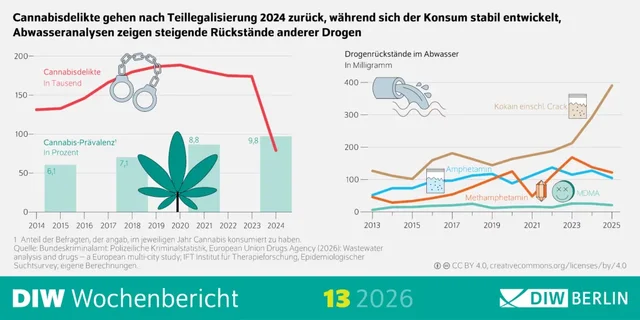
Crucially, however, there was no ‘discernible structural change in the reform year 2024’, and the gradual upwards trend long predates the law change.
Of the respondents who reported consuming any drugs in 2024, 63.6% used cannabis, making it by far the most prevalent drug other than alcohol and tobacco.
Public opinion on the law remained evenly split, with a Spring 2025 survey finding that 38% of respondents want to reverse the law, while exactly 38% want to keep it in place.
A second data stream comes from bespoke wastewater measurements commissioned as part of the official EKOCAN scientific evaluation of the CanG, samples taken specifically in the months immediately before and after the law came into force.
Unlike survey data, which may be subject to reporting bias, wastewater analysis directly captures aggregate consumption.
The DIW report combined data sets from both the official EKOCAN study, which evaluated the immediate impact of CanG on cannabis use, alongside the broader EUDA dataset, where city-level coverage is more inconsistent across the years.
Those EKOCAN measurements found no systematic change in cannabis residue levels around the April 2024 reform date.
Meanwhile, the EUDA’s 2025 dataset, based on samples from March to May, shows Germany among the highest cannabis consumption levels in Europe, alongside the Netherlands and Slovenia. Crucially, overall cannabis metabolite levels across Europe were flat year-on-year, with no evidence of Germany diverging from that trend.
It’s worth noting that this data does not show exact consumption quantities, suggesting that while the number of cannabis users may have remained stable, the amount existing users consumed may still have changed.
Street prices have similarly remained stable throughout, with the average retail price for cannabis holding at around €10 per gram, broadly equivalent to medical cannabis pricing, with no meaningful movement following the reform.
As noted in our recently launched report, German Cannabis Intel: Insights & Market Data, a new quarterly German market report we’re publishing in partnership with Grünhorn, this is more expensive than the average price of medical cannabis.
As the German cannabis industry eagerly awaits the confirmation on what amendments to the MedCanG bill will ultimately be implemented, this data provides valuable insights beyond the fervent political rhetoric.
The report directly acknowledges the highly polarised political discourse surrounding the law, noting that statements from within the governing parties range from calling it ‘a real shit law’ to describing it as a ‘right and long overdue step’.
Critically, the authors argue that the intense political and public fixation on cannabis is misplaced, while stating explicitly that if the political desire is to reduce cannabis consumption, a renewed ban is ‘not necessarily the most effective lever’ to pull.
Firstly, while they make it clear that the medical risks of cannabis should not be trivialised, they suggest ‘education and prevention’ are far more effective tools than criminalisation.
Furthermore, and perhaps more importantly, they draw attention to some of the more alarming findings of their study, namely the surging use of cocaine, crack, methamphetamine, and the anticipated rise of synthetic opioids, suggesting resources should be funnelled towards tackling these more dangerous substances.

These conclusions were, to a surprising extent, shared by Germany’s largest police union, the GdP, which has been vocal on its position on the reforms since before they came into force.
In a recent position paper on the proposed amendments to MedCanG, which they suggest are ‘fundamentally sensible’, the union notes that tightening access to medical cannabis while recreational access remains relatively open and anonymous may not achieve the intended steering effect.
If the formalities of obtaining a medical prescription become more burdensome, the union argues, some patients, or those using the medical route for recreational purposes, may simply forgo it. The result could be a shift in behaviour that leaves the underlying demand pattern unchanged while reducing the visibility of consumption within regulated channels.
While the falling crime figures may be statistical, spending less time criminalising cannabis users is likely to win favour from the police force.
Just a day before the DIW report was published, the GdP warned in a separate statement that operational demands on officers remain high and in many respects are increasing.
GdP Federal Chairman Jochen Kopelke has called on all state governments to address what the union describes as a serious deterioration in the policing situation, citing more complex operational scenarios, new forms of crime, and expanding task requirements.
Meanwhile, a shortage of recruits across multiple federal states is compounding the pressure, leaving existing staff under sustained strain with a limited prospect of reinforcement.
The post Stable Consumption, Falling Arrests: Germany’s Cannabis Landscape 2-Years On appeared first on Business of Cannabis.
Continue reading...
It has been a whirlwind 24 months for the country’s medical cannabis industry, and Germany has imported record amounts of medical cannabis almost every quarter over the period.
Yet, a new analysis of police data, population surveys, and wastewater measurements suggests that the amount of cannabis being consumed in Germany has remained stable, once again flying in the face of government accusations of ‘clear abuse’.
The new report from the German Institute for Economic Research (DIW Berlin), published on March 25, showed no structural or systematic changes in cannabis consumption, even as the use of other drugs spiked.
What does the data show?
The DIW, perhaps unsurprisingly, reported a sharp decline in recorded cannabis offenses since partial legalisation, dropping from around 174,000 in 2023 to just 62,000 in 2024, or around 79,000 when new CanG and MedCanG violations are included.
As a consequence of the declining cannabis offences recorded, overall drug offences in Germany also fell significantly, from 346,877 in 2023 to 228,104 in 2024.
When something becomes legal, the recorded offence count falls by definition, regardless of whether the underlying behaviour has changed. The drop, the DIW notes, is primarily a statistical artefact of legalisation rather than evidence of genuine market contraction or any meaningful shift in consumption patterns.
With that in mind, the authors looked to multiple data sources, including the recent European Drugs Agency (EUDA) wastewater analysis, which we covered here, to determine the actual impact of CanG on consumption levels.
Survey data from the Epidemiologischer Suchtsurvey (ESA), a nationally representative study conducted every three years since 1980, shows 12-month cannabis prevalence in adults ages 18-64 rose gradually from 4.5% in 2012 to 9.8% in 2024.
Crucially, however, there was no ‘discernible structural change in the reform year 2024’, and the gradual upwards trend long predates the law change.
Of the respondents who reported consuming any drugs in 2024, 63.6% used cannabis, making it by far the most prevalent drug other than alcohol and tobacco.
Public opinion on the law remained evenly split, with a Spring 2025 survey finding that 38% of respondents want to reverse the law, while exactly 38% want to keep it in place.
A second data stream comes from bespoke wastewater measurements commissioned as part of the official EKOCAN scientific evaluation of the CanG, samples taken specifically in the months immediately before and after the law came into force.
Unlike survey data, which may be subject to reporting bias, wastewater analysis directly captures aggregate consumption.
The DIW report combined data sets from both the official EKOCAN study, which evaluated the immediate impact of CanG on cannabis use, alongside the broader EUDA dataset, where city-level coverage is more inconsistent across the years.
Those EKOCAN measurements found no systematic change in cannabis residue levels around the April 2024 reform date.
Meanwhile, the EUDA’s 2025 dataset, based on samples from March to May, shows Germany among the highest cannabis consumption levels in Europe, alongside the Netherlands and Slovenia. Crucially, overall cannabis metabolite levels across Europe were flat year-on-year, with no evidence of Germany diverging from that trend.
It’s worth noting that this data does not show exact consumption quantities, suggesting that while the number of cannabis users may have remained stable, the amount existing users consumed may still have changed.
Street prices have similarly remained stable throughout, with the average retail price for cannabis holding at around €10 per gram, broadly equivalent to medical cannabis pricing, with no meaningful movement following the reform.
As noted in our recently launched report, German Cannabis Intel: Insights & Market Data, a new quarterly German market report we’re publishing in partnership with Grünhorn, this is more expensive than the average price of medical cannabis.
READ MORE…
Germany’s Medical Cannabis Product Range Quadruples as Prices Fall 30%
Deals, Courts and Coalition Splits: Germany’s Cannabis Market Braces for Change
Is the German Cannabis Boom Slowing Down, or Simply Normalising?
Data vs Politics
As the German cannabis industry eagerly awaits the confirmation on what amendments to the MedCanG bill will ultimately be implemented, this data provides valuable insights beyond the fervent political rhetoric.
The report directly acknowledges the highly polarised political discourse surrounding the law, noting that statements from within the governing parties range from calling it ‘a real shit law’ to describing it as a ‘right and long overdue step’.
Critically, the authors argue that the intense political and public fixation on cannabis is misplaced, while stating explicitly that if the political desire is to reduce cannabis consumption, a renewed ban is ‘not necessarily the most effective lever’ to pull.
Firstly, while they make it clear that the medical risks of cannabis should not be trivialised, they suggest ‘education and prevention’ are far more effective tools than criminalisation.
Furthermore, and perhaps more importantly, they draw attention to some of the more alarming findings of their study, namely the surging use of cocaine, crack, methamphetamine, and the anticipated rise of synthetic opioids, suggesting resources should be funnelled towards tackling these more dangerous substances.
These conclusions were, to a surprising extent, shared by Germany’s largest police union, the GdP, which has been vocal on its position on the reforms since before they came into force.
In a recent position paper on the proposed amendments to MedCanG, which they suggest are ‘fundamentally sensible’, the union notes that tightening access to medical cannabis while recreational access remains relatively open and anonymous may not achieve the intended steering effect.
If the formalities of obtaining a medical prescription become more burdensome, the union argues, some patients, or those using the medical route for recreational purposes, may simply forgo it. The result could be a shift in behaviour that leaves the underlying demand pattern unchanged while reducing the visibility of consumption within regulated channels.
While the falling crime figures may be statistical, spending less time criminalising cannabis users is likely to win favour from the police force.
Just a day before the DIW report was published, the GdP warned in a separate statement that operational demands on officers remain high and in many respects are increasing.
GdP Federal Chairman Jochen Kopelke has called on all state governments to address what the union describes as a serious deterioration in the policing situation, citing more complex operational scenarios, new forms of crime, and expanding task requirements.
Meanwhile, a shortage of recruits across multiple federal states is compounding the pressure, leaving existing staff under sustained strain with a limited prospect of reinforcement.
The post Stable Consumption, Falling Arrests: Germany’s Cannabis Landscape 2-Years On appeared first on Business of Cannabis.
Continue reading...


