
Over the last few weeks, the UK’s medical cannabis industry has been written about in The Times, The Guardian, the BBC, The i Paper, Private Eye, and a swathe of other national and local publications.
The reasons behind this recent media storm are clear, and the core criticism is justified. The tragic death of Oliver Robinson has exposed flaws in the country’s prescribing system that both industry and government should address with urgency.
Oliver’s Law, the campaign launched by his family to address these issues and the driving force behind much of this recent coverage, calls for common-sense measures that would be standard in any other medical setting.
The issue is not with the law’s demands or the calls to hold those in the industry who do not meet clinical standards accountable. Rather, it is the representation of the industry at large baked into this coverage.
Claims made that ‘regulatory oversight of cannabis clinics has, to date, been limited’, or that industry players can be ‘handsomely rewarded’, are misleading.
Peter Reynolds, president of CLEAR Cannabis Law Reform, told Business of Cannabis: “Nobody, to my knowledge, is making a fortune. To my knowledge, the best most people are doing is making a living. It’s so highly regulated, the demands are so enormous, you can’t make a fortune, actually.”
While being candid that ‘some bad actors’ and ‘some irresponsible prescribing’ exist, on the whole, the ‘industry is behaving very well, and the protocols that are in place, providing they are followed, are fine’.
The industry, by and large, is not arguing against reform. It is arguing against being misrepresented as negligent, money-hungry, and irresponsible, when the vast majority of clinics go to great lengths to prioritise patient safety.
The Oliver’s Law campaign, established following the death of Oliver Robinson, a 34-year-old patient whose prescription was found by a coroner to have contributed to his death, is calling for several key changes. These include no cannabis prescriptions for patients with serious and complex mental illness following a single video consultation, a central NHS registry recording every prescription issued, and routine CQC inspections with published prescribing data.
These measures are common sense. Many clinics operating to best practice already meet or exceed these standards. The CQC’s own inspection record shows that where failures have occurred, they have been concentrated among a small number of providers, not distributed across the market as a whole.
Graham Woodward, Chief Medical Officer of Releaf Clinic, one of the UK’s largest private cannabis clinics, says every patient where psychiatry is identified as a concern, even where the primary presenting condition is pain or another physical complaint, is rerouted to one of the clinic’s four consultant psychiatrists or three psychiatric nurses before any prescription is issued.

UK Policy
A growing campaign to tighten safeguards around cannabis prescribing in the UK could have far-reaching implications for access, oversight and clinical accountability.
By Ben Stevens
Read story →
“Any changes that come through the CQC or around prescribing practice do not concern me,” Woodward says, “because we have never deviated from good practice and standards.”
Woodward’s background is relevant here; he is a registered mental health nurse with 28 years of healthcare leadership experience across statutory, voluntary and private sectors.
Releaf operates as a designated body under NHS revalidation rules, has direct access to NHS Spine, and holds several multidisciplinary team reviews daily.
Notably, he explained that between 30% and 40% of patients who complete triage and reach a consultation still do not receive a prescription. The clinic is also a participating member in DICE, Digital Integrated Care Excellence, a monthly forum that includes the MHRA, CQC, ASA and GPhC.
Crucially, none of these features is in the coverage that has followed Oliver Robinson’s death. This means that the public debate is being conducted without information to distinguish isolated regulatory failures from the standards that much of the industry has quietly built and maintained
As we’ve reported extensively, a recurring issue in the UK industry is fractured data collection.
Business of Cannabis‘s own analysis of NHSBSA FOI data, published in October 2025, found a dataset of over 132,000 data points with no standardised naming conventions, significant duplication, and product match rates as low as 77.5% for 2022, meaning nearly one in four prescription records from that year could not be reliably assigned to a specific product.
The NHSBSA itself acknowledged in its FOI response that private cannabis prescriptions are ‘manually recorded from often handwritten prescriptions’ with ‘no standardised naming convention for the product names, strength, or volume.’
Woodward explained: “If they do not understand what it is, it goes into an ‘other’ box. I believe there are thousands and thousands of prescriptions going into ‘other’ and never being counted as cannabis prescriptions, because the people inputting the data manually do not know what the medication is.”
The result, he argues, is a patient population significantly larger than official figures suggest, he estimates at least 100,000 active patients, against the 50,000 figure widely cited.
The same manual entry process applies to prescriber codes. If product names are routinely misrecorded, prescriber attribution is subject to the same risk of error.
The prescriber-level breakdown that powers The Times‘ central claim that ten doctors issued more than half of all cannabis medications since 2019 does not appear in any publicly available NHSBSA dataset. It was obtained via a bespoke FOI request whose response has not been published. Business of Cannabis has therefore been unable to independently verify it.
This does not mean the concerns about prescribing concentration are unfounded. It means the evidence base for the specific claim has not been subjected to the scrutiny it requires.
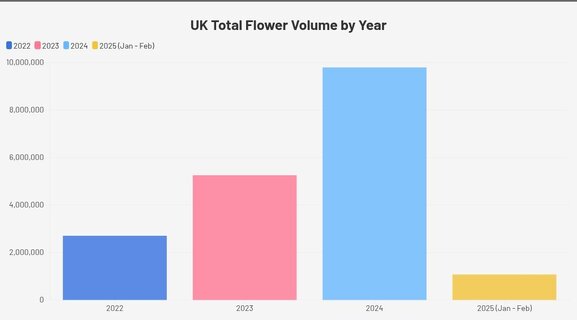
Business of Cannabis can confirm that the aggregate volume figures cited in the Times are broadly consistent with published FOI data: private prescriptions for unlicensed cannabis-based medicines reached approximately 283,000 items in 2023 and approximately 659,000 in 2024.
The growth is real, but the conclusions drawn from it are based on an incomplete picture. Accepting the limitations of the underlying data, the scale of the market warrants context rather than alarm.
At approximately 659,000 items in 2024, private cannabis prescribing remains a small fraction of the medicines prescribed for the conditions it predominantly treats.
More than 5.6 million people in the UK have received an opioid-based prescription for chronic pain, according to NHSBSA data. The British Pain Society estimates 28 million UK adults live with chronic pain.
The 2018 rescheduling of cannabis-based medicines was authorised following a review by Professor Dame Sally Davies, then Chief Medical Officer for England, which found ‘conclusive or substantial evidence that cannabis or cannabinoids are effective for the treatment of chronic pain in adults’, evidence base that extended well beyond paediatric epilepsy, despite how the 2018 decision is sometimes characterised.
Glass Pharms, the UK’s largest domestic cannabis cultivator, has argued that 100,000 items per month implies approximately 30,000 active patients in any given month across all conditions, a figure it places against the estimated 1.77 million people in the UK using cannabis to treat medical conditions and the 5.6 million receiving opioid prescriptions for pain.
James Leavesley, CEO of UK clinic Dalgety, puts the regulatory context plainly: “The current level of prescribing of cannabis-based products for medicinal use in the UK remains modest when viewed in the context of broader healthcare demand. Millions of patients live with conditions such as chronic pain, yet access to CBPMs is still tightly governed by specialist prescribing and clear clinical need.
“It is important to recognise that these medicines sit within the well-established ‘specials’ framework, where responsibility for prescribing rests with clinicians acting in the best interests of individual patients. This is not a volume-driven model, but a clinically led one.
“As the sector develops, the focus should remain on maintaining high standards, ensuring products are produced consistently, safely, and in line with regulatory expectations. For us, that means building a UK-based supply model aligned to patient need, rather than volume alone.
“The conversation should be centred on quality, governance, and patient outcomes, rather than scale in isolation.”
Releaf holds outcome data from approximately 10,200 patients, collected using validated instruments, including the EQ-5D, GAD-7, BPI, and PHQ-9, tools licenced from specialist providers. Of approximately 7,000 EQ-5D responses, around 75% show improvements in overall quality of life. Of approximately 1,500 GAD-7 responses assessing anxiety, 1,200 showed significant improvement.
“Why does no one come and ask to see the data?” Woodward says. “We are an open book. We would happily share it with The Mirror, The Sun, The Times, whoever wants to see it.”
Patients taking legally prescribed medicines already face stigma at work, misunderstandings with law enforcement, difficulties at pharmacies, and are reluctant to disclose their treatment to GPs.
Misrepresenting the industry at large ultimately impacts the patients it aims to protect. Reform built on an accurate picture of the market will be more effective, more durable, and fairer to patients. A central registry, one of Oliver’s Law’s key demands, and one that the industry should welcome, would be a meaningful step towards that picture.
The post The Right Reforms, the Wrong Narrative: Why the Medical Cannabis Debate Is Missing Half the Picture appeared first on Business of Cannabis.
Continue reading...
The reasons behind this recent media storm are clear, and the core criticism is justified. The tragic death of Oliver Robinson has exposed flaws in the country’s prescribing system that both industry and government should address with urgency.
Oliver’s Law, the campaign launched by his family to address these issues and the driving force behind much of this recent coverage, calls for common-sense measures that would be standard in any other medical setting.
The issue is not with the law’s demands or the calls to hold those in the industry who do not meet clinical standards accountable. Rather, it is the representation of the industry at large baked into this coverage.
Claims made that ‘regulatory oversight of cannabis clinics has, to date, been limited’, or that industry players can be ‘handsomely rewarded’, are misleading.
Peter Reynolds, president of CLEAR Cannabis Law Reform, told Business of Cannabis: “Nobody, to my knowledge, is making a fortune. To my knowledge, the best most people are doing is making a living. It’s so highly regulated, the demands are so enormous, you can’t make a fortune, actually.”
While being candid that ‘some bad actors’ and ‘some irresponsible prescribing’ exist, on the whole, the ‘industry is behaving very well, and the protocols that are in place, providing they are followed, are fine’.
The industry, by and large, is not arguing against reform. It is arguing against being misrepresented as negligent, money-hungry, and irresponsible, when the vast majority of clinics go to great lengths to prioritise patient safety.
What Oliver’s Law is actually asking for
The Oliver’s Law campaign, established following the death of Oliver Robinson, a 34-year-old patient whose prescription was found by a coroner to have contributed to his death, is calling for several key changes. These include no cannabis prescriptions for patients with serious and complex mental illness following a single video consultation, a central NHS registry recording every prescription issued, and routine CQC inspections with published prescribing data.
These measures are common sense. Many clinics operating to best practice already meet or exceed these standards. The CQC’s own inspection record shows that where failures have occurred, they have been concentrated among a small number of providers, not distributed across the market as a whole.
Graham Woodward, Chief Medical Officer of Releaf Clinic, one of the UK’s largest private cannabis clinics, says every patient where psychiatry is identified as a concern, even where the primary presenting condition is pain or another physical complaint, is rerouted to one of the clinic’s four consultant psychiatrists or three psychiatric nurses before any prescription is issued.
UK Policy
Oliver’s Law: The Campaign That Could Reshape UK Cannabis Prescribing
A growing campaign to tighten safeguards around cannabis prescribing in the UK could have far-reaching implications for access, oversight and clinical accountability.
By Ben Stevens
Read story →
“Any changes that come through the CQC or around prescribing practice do not concern me,” Woodward says, “because we have never deviated from good practice and standards.”
Woodward’s background is relevant here; he is a registered mental health nurse with 28 years of healthcare leadership experience across statutory, voluntary and private sectors.
Releaf operates as a designated body under NHS revalidation rules, has direct access to NHS Spine, and holds several multidisciplinary team reviews daily.
Notably, he explained that between 30% and 40% of patients who complete triage and reach a consultation still do not receive a prescription. The clinic is also a participating member in DICE, Digital Integrated Care Excellence, a monthly forum that includes the MHRA, CQC, ASA and GPhC.
Crucially, none of these features is in the coverage that has followed Oliver Robinson’s death. This means that the public debate is being conducted without information to distinguish isolated regulatory failures from the standards that much of the industry has quietly built and maintained
What the data tells us, and what it can’t
As we’ve reported extensively, a recurring issue in the UK industry is fractured data collection.
Business of Cannabis‘s own analysis of NHSBSA FOI data, published in October 2025, found a dataset of over 132,000 data points with no standardised naming conventions, significant duplication, and product match rates as low as 77.5% for 2022, meaning nearly one in four prescription records from that year could not be reliably assigned to a specific product.
The NHSBSA itself acknowledged in its FOI response that private cannabis prescriptions are ‘manually recorded from often handwritten prescriptions’ with ‘no standardised naming convention for the product names, strength, or volume.’
Woodward explained: “If they do not understand what it is, it goes into an ‘other’ box. I believe there are thousands and thousands of prescriptions going into ‘other’ and never being counted as cannabis prescriptions, because the people inputting the data manually do not know what the medication is.”
The result, he argues, is a patient population significantly larger than official figures suggest, he estimates at least 100,000 active patients, against the 50,000 figure widely cited.
The same manual entry process applies to prescriber codes. If product names are routinely misrecorded, prescriber attribution is subject to the same risk of error.
The prescriber-level breakdown that powers The Times‘ central claim that ten doctors issued more than half of all cannabis medications since 2019 does not appear in any publicly available NHSBSA dataset. It was obtained via a bespoke FOI request whose response has not been published. Business of Cannabis has therefore been unable to independently verify it.
This does not mean the concerns about prescribing concentration are unfounded. It means the evidence base for the specific claim has not been subjected to the scrutiny it requires.
Business of Cannabis can confirm that the aggregate volume figures cited in the Times are broadly consistent with published FOI data: private prescriptions for unlicensed cannabis-based medicines reached approximately 283,000 items in 2023 and approximately 659,000 in 2024.
READ MORE…

Europe’s CBD U-Turn Set To Cause Widespread Harm To Businesses And Consumers

Green Shoots: Spring 2026 Brings Integration, Recovery, and New Supply Chains to Global Cannabis

Five Years, 74 Patients: Ireland Moves Forward With Review of Its Failing Medical Cannabis Programme

CBD Enters US Healthcare Through Medicare Pilot, But Coverage Remains Limited
The growth is real, but the conclusions drawn from it are based on an incomplete picture. Accepting the limitations of the underlying data, the scale of the market warrants context rather than alarm.
At approximately 659,000 items in 2024, private cannabis prescribing remains a small fraction of the medicines prescribed for the conditions it predominantly treats.
More than 5.6 million people in the UK have received an opioid-based prescription for chronic pain, according to NHSBSA data. The British Pain Society estimates 28 million UK adults live with chronic pain.
The 2018 rescheduling of cannabis-based medicines was authorised following a review by Professor Dame Sally Davies, then Chief Medical Officer for England, which found ‘conclusive or substantial evidence that cannabis or cannabinoids are effective for the treatment of chronic pain in adults’, evidence base that extended well beyond paediatric epilepsy, despite how the 2018 decision is sometimes characterised.
Glass Pharms, the UK’s largest domestic cannabis cultivator, has argued that 100,000 items per month implies approximately 30,000 active patients in any given month across all conditions, a figure it places against the estimated 1.77 million people in the UK using cannabis to treat medical conditions and the 5.6 million receiving opioid prescriptions for pain.
James Leavesley, CEO of UK clinic Dalgety, puts the regulatory context plainly: “The current level of prescribing of cannabis-based products for medicinal use in the UK remains modest when viewed in the context of broader healthcare demand. Millions of patients live with conditions such as chronic pain, yet access to CBPMs is still tightly governed by specialist prescribing and clear clinical need.
“It is important to recognise that these medicines sit within the well-established ‘specials’ framework, where responsibility for prescribing rests with clinicians acting in the best interests of individual patients. This is not a volume-driven model, but a clinically led one.
“As the sector develops, the focus should remain on maintaining high standards, ensuring products are produced consistently, safely, and in line with regulatory expectations. For us, that means building a UK-based supply model aligned to patient need, rather than volume alone.
“The conversation should be centred on quality, governance, and patient outcomes, rather than scale in isolation.”
The patients in the middle
Releaf holds outcome data from approximately 10,200 patients, collected using validated instruments, including the EQ-5D, GAD-7, BPI, and PHQ-9, tools licenced from specialist providers. Of approximately 7,000 EQ-5D responses, around 75% show improvements in overall quality of life. Of approximately 1,500 GAD-7 responses assessing anxiety, 1,200 showed significant improvement.
“Why does no one come and ask to see the data?” Woodward says. “We are an open book. We would happily share it with The Mirror, The Sun, The Times, whoever wants to see it.”
Patients taking legally prescribed medicines already face stigma at work, misunderstandings with law enforcement, difficulties at pharmacies, and are reluctant to disclose their treatment to GPs.
Misrepresenting the industry at large ultimately impacts the patients it aims to protect. Reform built on an accurate picture of the market will be more effective, more durable, and fairer to patients. A central registry, one of Oliver’s Law’s key demands, and one that the industry should welcome, would be a meaningful step towards that picture.
The post The Right Reforms, the Wrong Narrative: Why the Medical Cannabis Debate Is Missing Half the Picture appeared first on Business of Cannabis.
Continue reading...

