
Live
Cannabis Europa 2026
London, UK
Arjan Roskam, Green House Genetics; Dave Auger, Big League Genetics; Adele Hollman, Sanity Group; moderated by Alex Fraser, Grow Group
Kristine Lütke, 365 Sherpas GmbH; Dirk Heitepriem, German Cannabis Business Association; Sascha Mielcarek, Canify; Niels Lutzhöft, Bird & Bird LLP; moderated by Moritz Förster, Krautinvest

‘The hottest topic in the European cannabis space right now,’ was how moderator Moritz Förster opened this session. Telemedicine has been the engine of Germany’s post-CanG growth, driving patient numbers and the 200-plus tonnes of imports recorded in 2025. Yet while international observers are busy admiring the German model, Germany itself is attempting to restrict it.
The draft law and why it has stalled
The legal case against the draft
The reimbursement threat and what the industry must do
The post Cannabis Europa London 2026: Key Insights, Day 2 appeared first on Business of Cannabis.
Continue reading...
Cannabis Europa 2026
London, UK
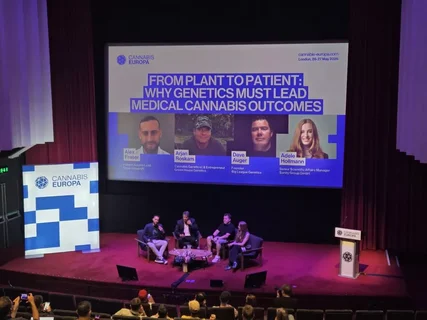
From Plant to Patient: Why Genetics Must Lead Medical Cannabis Outcomes
Arjan Roskam, Green House Genetics; Dave Auger, Big League Genetics; Adele Hollman, Sanity Group; moderated by Alex Fraser, Grow Group
- Adele Hollman, Medical Affairs Manager at Sanity Group, told the room: ‘Genetics is the first variable we can control to have a predictable outcome for patients. If we get this right, everything else in the process follows.’
- The post-harvest stage was identified as the point at which the industry most consistently fails patients. ‘Nine out of ten producers are cutting corners, drying in six, seven, eight days when everybody knows you need 14,’ Roskam said. ‘Companies under financial pressure are putting product on the market too quickly, and patients are the ones paying for it.’
- Strain mislabelling compounds the problem. Distributors buying genetics and rebranding them under different names means patients who find a product that works cannot reliably access it again.
- The feedback loop between patient outcomes and breeders is almost entirely absent. ‘We rarely ask the patient what effect they received from the end product,’ Hollman said. ‘We don’t have the chance to develop specific products for specific conditions because we don’t track the data and feed it back to the breeder.’
- Roskam is launching a tool called Cannabigator within the month, an app allowing patients to input their conditions and current medications and receive a recommended cannabinoid profile, with a parallel interface for clinicians. ‘The doctors think they always want to prescribe 25% THC, but 25% doesn’t mean it’s always good for you. A Sativa at 22 or 23% can be much more beneficial, and people don’t realise that.’
- On the question of clinical language, Hollman proposed a workable middle ground. ‘Strain names are good for cultural knowledge and patient familiarity, but chemo-vars, the exact chemical fingerprint, are the language for doctors. Both can work together.’
- Auger pointed to regulatory fragmentation as a direct barrier to product quality. ‘Fresh cannabis is like fresh bread, it’s just better. When you’ve got different regulatory hurdles in every country, patients end up with something that’s been through the shipping process for six months.’
Telemedicine in Germany: Maturity, Regulation and What Comes Next
Kristine Lütke, 365 Sherpas GmbH; Dirk Heitepriem, German Cannabis Business Association; Sascha Mielcarek, Canify; Niels Lutzhöft, Bird & Bird LLP; moderated by Moritz Förster, Krautinvest
‘The hottest topic in the European cannabis space right now,’ was how moderator Moritz Förster opened this session. Telemedicine has been the engine of Germany’s post-CanG growth, driving patient numbers and the 200-plus tonnes of imports recorded in 2025. Yet while international observers are busy admiring the German model, Germany itself is attempting to restrict it.
The draft law and why it has stalled
- The health ministry’s proposed restrictions centred on two elements: a mandatory in-person consultation at the start of therapy, and a ban on mail-order delivery of cannabis flowers. The draft passed its first parliamentary reading in December 2025. Since then, near silence.
- Sascha Mielcarek, CEO of Canify, was direct about the political reality. ‘It’s a bit of a fake discussion, used to trade positions. Do you want people to go back to an illicit market where they don’t pay taxes, while you’re doing economic reforms to save money and increase taxes? I think that’s the real question.’ He does not expect imminent movement, but warned that the danger remains. ‘It’s an open law. It can be represented to parliament at any time.’
- Kristine Lütke, former member of the Bundestag and one of the architects of the original medical cannabis legislation, was equally unconvinced by the public health rationale. ‘I’m not convinced that restricting telemedicine and flower delivery will have any positive effect on public health. People will go back to the illicit market, or patients will have home-grown cannabis that is not quality-controlled. I don’t see any positive effect.’
- Dirk Heitepriem, President of the German Cannabis Business Association, reached back to first principles. ‘We reminded politicians where we came from — why medical cannabis was legalised in Germany in 2017. It was a court decision: either allow the patient to grow at home, or give them regulated access. They said we don’t want home growing because quality can’t be secured. That’s something they need to remember.’
The legal case against the draft
- Niels Lutzhöft, partner at Bird & Bird, outlined why the draft faces serious legal challenges. It is inconsistent with Germany’s own descheduling of cannabis, now a prescription medicine; it cannot be treated differently from any other medicine without justification. The Federal Constitutional Court has a consistent record of striking down inconsistent legislation.
- Regulating the conduct of doctors located outside Germany also creates EU law problems. ‘If those doctors are located outside Germany, their conduct is being regulated — and that requires proper justification. Now that cannabis is descheduled, arguing it is equivalent to a narcotic becomes very difficult,’ he said. A referral to the Court of Justice of the EU on related advertising restrictions is already in motion.
- A recent Supreme Court ruling prohibiting platforms from advertising cannabis with specific medical indications also drew attention. Mielcarek said compliant platforms were unaffected. He offered a broader point: ‘If you look at those websites posting flower pictures and strain names — that’s what’s drawing the attention. There’s no business case for not adapting to a more medically presented industry. It would help both sides.’
The reimbursement threat and what the industry must do
- A separate proposal to end public health insurance reimbursement for cannabis flowers drew the sharpest response of the session. ‘That is an attack on the really, really ill people,’ Heitepriem said. ‘We are moving from “we don’t like potential recreational users entering the medical market” to “we will take away the reimbursement from people who are genuinely sick.” That is a brutal idea.’ He noted the fiscal argument barely holds up: the cost to statutory insurers is negligible against the wider healthcare budget, making it a political rather than economic decision.
- Heitepriem closed with a direct call to action. ‘The stronger the industry represents itself as one voice, the better. Join your industry associations, work with patient groups, with doctors, and with pharmacies. Build common positions. That is the only way this works.’ He acknowledged self-regulation remains elusive in a market still changing rapidly, but argued that a unified industry message, aligned with patients and clinicians, is the most powerful tool available.
- Mielcarek offered the session’s most succinct defence of the German model. Statistics show there are no more users, people are moving from the illicit market to a formalised, standardised, quality-controlled market. I would call that a success. So I wonder why we are having this discussion at all.’
The post Cannabis Europa London 2026: Key Insights, Day 2 appeared first on Business of Cannabis.
Continue reading...


