
South Africa, according to its own government, already has a cannabis industry worth up to R28bn (£1.28bn).
Last month, the Portfolio Committee on Trade, Industry and Competition convened to hammer out the details of its aptly-named National Cannabis Master Plan, aiming to legitimise and regulate the already thriving, but almost entirely underground market.
During the session, Ncumisa Mcata-Mhlauli, chief director of agro-processing and forestry-based industries at the DTIC (Department of Trade, Industry and Competition), told the committee that the government was targeting an ambitious 10% annual growth from an estimated R14 billion base.
However, she acknowledged the total market could be closer to R28 billion, with roughly half operating within the illicit economy, while estimating that the formal cannabis industry currently generates around R5.5 billion in annual revenue.
These three separate figures, all emerging from the same session, are illustrative of the very issue this legislation aims to address.
Following the decriminalisation of private cannabis cultivation and possession in 2018, John Jeffery, project manager for the Hemp and Cannabis Master Plan, told MPs: “The legal situation is not desirable. It’s quite confusing.”
Charl Botha, a legal strategist and cannabis policy specialist who has been involved in parliamentary briefings and regulatory submissions across the sector, believes the issues run much deeper than a lack of legal clarity.
“When the numbers keep shifting depending on who is speaking, Parliament loses a shared point of reference,” Botha said. “The scale of the opportunity, the urgency of reform, and the level of intervention required all become blurred.”
According to Botha’s own analysis, which drew on observed production, processing, and retail activity, the cannabis retail economy is worth approximately R9–10 billion annually, anchored in roughly 550 tonnes of flower moving through an estimated 8,500 stores and 2,500 clubs operating daily regardless of their legal status.
“The question is how to bring an existing multi-billion rand market into the formal, taxable, and regulated economy,” Botha argues.
Though not formally legalised, the cannabis economy has largely been left alone to grow and develop over the past eight years.
There is an established retail network embedded across South Africa’s cities, towns and rural supply chains, with a wide array of businesses turning over anywhere from R100,000 a month to R100,000 a day, according to Botha’s analysis.
As in almost every market, flower represents the highest volume and the broadest consumer base. Vapes operate at a higher price point with better margins, particularly in urban markets. Edibles expand the consumer base but introduce dosing variability that complicates both measurement and regulation.
Currently, Under Section 21 of the Medicines and Related Substances Act, doctors can apply to SAHPRA for special permission to access unregistered medicines like cannabis for individual patients.
Some retail outlets have sought to operate under a broader interpretation of this provision, effectively treating it as a general retail licence.
While Section 21 authorisations are patient-specific, require a registered doctor, and carry no provision for open retail, those operating under this skin-deep legal guise are left to flourish in the country’s grey market.
An LSF industrialisation study, published in March 2026 in partnership with the Presidency, the IDC and the DTIC, estimates the domestic hemp industry alone could grow from R7.3 billion in 2025 to R40.4 billion by 2040, but only with coordinated policy support.
The National Cannabis Master Plan has been in development since a Cabinet decision in July 2019.
Originally convened by the Department of Agriculture, it was transferred to the DTIC in 2024 as the government moved to consolidate policy under a single commercial lead. President Ramaphosa gave it his most explicit public endorsement yet in his 2025 State of the Nation Address, stating: “We want South Africa to lead in the commercial production of hemp and cannabis”.
It is organised around nine pillars. These include establishing effective regulatory systems, sustainable seed supply, research and technology, producer support, market development, enterprise and supplier development, manufacturing and product development, education and training, and communications. In addition, each of these will see a separate government department take the lead, with 10 departments involved in total.
As Botha points out, this could introduce even more complexity and confusion to the market.
“Complexity is repeatedly cited as the reason for slow progress, multiple departments, overlapping mandates, layered laws,” he cautioned.
Citing the thriving hemp industry as an example of how these issues can be tackled, Botha added: “The record from Parliament shows the challenges are defined, the solutions are on the table, and the intended outcomes are agreed. The pressure point is now implementation.”
The commercial industry will similarly be split into four distinct areas, including medicine, textiles, cosmetics, and food. For the first time, it will also establish a pathway for existing cannabis cultivators to legitimise their operations.
“A large slice of existing cultivation stays outside the legal system altogether,” Botha explained. “These producers are not refusing to join the regulated space, there is simply no accessible door for them to walk through.”
Despite such a detailed plan, without a legislative backbone pushing these recommendations through parliament, it will remain just that.
The National Cannabis Master Plan is not law, nor is the Hemp and Cannabis Commercialisation Policy, expected to come before Cabinet in April 2026.
The Cannabis Bill, the instrument that would actually push these proposals into law, is expected to be introduced into parliament in mid-2027 at the earliest.
“Substantive reform is not measured by the publication of frameworks,” Botha said. “It is measured by outcomes. Can individuals participate lawfully without ambiguity? Can organisations structure themselves with confidence in their compliance position? Can institutions provide consistent, reasoned responses that enable rather than delay?”
Every department that appeared before the March committee, he suggests, is broadly in favour of reform and agrees on a plan.
Yet, the ‘issue is not disagreement’, but the ‘absence of integration’. “These perspectives operate in parallel rather than as parts of a single, aligned framework.”
Much like consumers in Germany, adults are able to grow and possess cannabis legally, but have no legitimate means of acquiring or distributing it, giving people little option but to turn to the illicit, grey, or medical markets.
Licensed operators who entered the formal system in good faith, investing in facilities, meeting regulatory standards, have no functional domestic market in which to participate. The informal market, carrying none of the same compliance costs, fills the void and undercuts on price.
South Africa, seemingly, has everything it needs for a regulated cannabis market to flourish, other than delivery.
“The constitutional debate is settled. The policy direction is clear,” Botha said. “What remains is delivery.
“Decision-making moves from years of uncertainty to targeted regulatory alignment in a matter of weeks if the political decision is made to use existing mechanisms rather than wait for a new system to be designed from scratch.”
The post Eight Years After Decriminalisation, South Africa’s Cannabis Industry Edges Towards Regulated Market appeared first on Business of Cannabis.
Continue reading...
Last month, the Portfolio Committee on Trade, Industry and Competition convened to hammer out the details of its aptly-named National Cannabis Master Plan, aiming to legitimise and regulate the already thriving, but almost entirely underground market.
During the session, Ncumisa Mcata-Mhlauli, chief director of agro-processing and forestry-based industries at the DTIC (Department of Trade, Industry and Competition), told the committee that the government was targeting an ambitious 10% annual growth from an estimated R14 billion base.
However, she acknowledged the total market could be closer to R28 billion, with roughly half operating within the illicit economy, while estimating that the formal cannabis industry currently generates around R5.5 billion in annual revenue.
These three separate figures, all emerging from the same session, are illustrative of the very issue this legislation aims to address.
Following the decriminalisation of private cannabis cultivation and possession in 2018, John Jeffery, project manager for the Hemp and Cannabis Master Plan, told MPs: “The legal situation is not desirable. It’s quite confusing.”
Charl Botha, a legal strategist and cannabis policy specialist who has been involved in parliamentary briefings and regulatory submissions across the sector, believes the issues run much deeper than a lack of legal clarity.
“When the numbers keep shifting depending on who is speaking, Parliament loses a shared point of reference,” Botha said. “The scale of the opportunity, the urgency of reform, and the level of intervention required all become blurred.”
According to Botha’s own analysis, which drew on observed production, processing, and retail activity, the cannabis retail economy is worth approximately R9–10 billion annually, anchored in roughly 550 tonnes of flower moving through an estimated 8,500 stores and 2,500 clubs operating daily regardless of their legal status.
“The question is how to bring an existing multi-billion rand market into the formal, taxable, and regulated economy,” Botha argues.
The market already exists
Though not formally legalised, the cannabis economy has largely been left alone to grow and develop over the past eight years.
There is an established retail network embedded across South Africa’s cities, towns and rural supply chains, with a wide array of businesses turning over anywhere from R100,000 a month to R100,000 a day, according to Botha’s analysis.
As in almost every market, flower represents the highest volume and the broadest consumer base. Vapes operate at a higher price point with better margins, particularly in urban markets. Edibles expand the consumer base but introduce dosing variability that complicates both measurement and regulation.
Currently, Under Section 21 of the Medicines and Related Substances Act, doctors can apply to SAHPRA for special permission to access unregistered medicines like cannabis for individual patients.
Some retail outlets have sought to operate under a broader interpretation of this provision, effectively treating it as a general retail licence.
While Section 21 authorisations are patient-specific, require a registered doctor, and carry no provision for open retail, those operating under this skin-deep legal guise are left to flourish in the country’s grey market.
An LSF industrialisation study, published in March 2026 in partnership with the Presidency, the IDC and the DTIC, estimates the domestic hemp industry alone could grow from R7.3 billion in 2025 to R40.4 billion by 2040, but only with coordinated policy support.
READ MORE…

Eight Years After Decriminalisation, South Africa’s Cannabis Industry Edges Towards Regulated Market

Bring It On: Meet the Cannabis CMO Welcoming Scrutiny With Open Arms
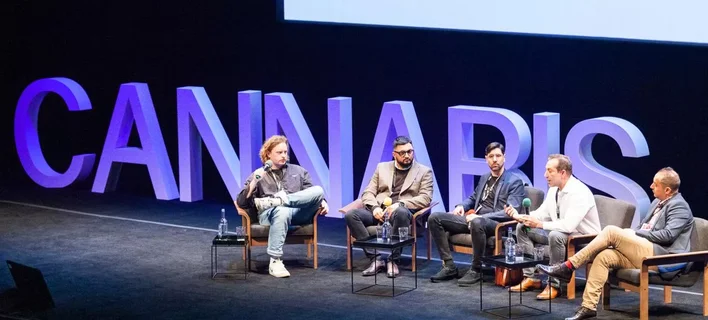
Cannabis Europa Heads to London Amid €1.5 Billion European Market Surge
The plan on paper
The National Cannabis Master Plan has been in development since a Cabinet decision in July 2019.
Originally convened by the Department of Agriculture, it was transferred to the DTIC in 2024 as the government moved to consolidate policy under a single commercial lead. President Ramaphosa gave it his most explicit public endorsement yet in his 2025 State of the Nation Address, stating: “We want South Africa to lead in the commercial production of hemp and cannabis”.
It is organised around nine pillars. These include establishing effective regulatory systems, sustainable seed supply, research and technology, producer support, market development, enterprise and supplier development, manufacturing and product development, education and training, and communications. In addition, each of these will see a separate government department take the lead, with 10 departments involved in total.
As Botha points out, this could introduce even more complexity and confusion to the market.
“Complexity is repeatedly cited as the reason for slow progress, multiple departments, overlapping mandates, layered laws,” he cautioned.
Citing the thriving hemp industry as an example of how these issues can be tackled, Botha added: “The record from Parliament shows the challenges are defined, the solutions are on the table, and the intended outcomes are agreed. The pressure point is now implementation.”
The commercial industry will similarly be split into four distinct areas, including medicine, textiles, cosmetics, and food. For the first time, it will also establish a pathway for existing cannabis cultivators to legitimise their operations.
“A large slice of existing cultivation stays outside the legal system altogether,” Botha explained. “These producers are not refusing to join the regulated space, there is simply no accessible door for them to walk through.”
Cannabis master plan ≠ legislative reform
Despite such a detailed plan, without a legislative backbone pushing these recommendations through parliament, it will remain just that.
The National Cannabis Master Plan is not law, nor is the Hemp and Cannabis Commercialisation Policy, expected to come before Cabinet in April 2026.
The Cannabis Bill, the instrument that would actually push these proposals into law, is expected to be introduced into parliament in mid-2027 at the earliest.
“Substantive reform is not measured by the publication of frameworks,” Botha said. “It is measured by outcomes. Can individuals participate lawfully without ambiguity? Can organisations structure themselves with confidence in their compliance position? Can institutions provide consistent, reasoned responses that enable rather than delay?”
Every department that appeared before the March committee, he suggests, is broadly in favour of reform and agrees on a plan.
Yet, the ‘issue is not disagreement’, but the ‘absence of integration’. “These perspectives operate in parallel rather than as parts of a single, aligned framework.”
Much like consumers in Germany, adults are able to grow and possess cannabis legally, but have no legitimate means of acquiring or distributing it, giving people little option but to turn to the illicit, grey, or medical markets.
Licensed operators who entered the formal system in good faith, investing in facilities, meeting regulatory standards, have no functional domestic market in which to participate. The informal market, carrying none of the same compliance costs, fills the void and undercuts on price.
South Africa, seemingly, has everything it needs for a regulated cannabis market to flourish, other than delivery.
“The constitutional debate is settled. The policy direction is clear,” Botha said. “What remains is delivery.
“Decision-making moves from years of uncertainty to targeted regulatory alignment in a matter of weeks if the political decision is made to use existing mechanisms rather than wait for a new system to be designed from scratch.”
The post Eight Years After Decriminalisation, South Africa’s Cannabis Industry Edges Towards Regulated Market appeared first on Business of Cannabis.
Continue reading...

