
Since April 2024, Germany has been firmly cemented at the centre of the global cannabis conversation, and for good reason.
The runaway growth of its medical market remains the envy of industry stakeholders throughout Europe, and is increasingly drawing the attention of some of the world’s largest cannabis companies and investment firms.
As the EU’s most populous country, and one of the first to legalise medical cannabis in 2017, Germany was already emerging as the regional frontrunner by the late 2010s.
While its potential as a market has always been clear, the explosion of growth brought about by Germany’s ‘Cannabis Act’ took even the most well-connected and experienced industry operators by surprise.
Stefan Fritsch, the founder and CEO of Grunhorn, one of Germany’s longest-running and largest cannabis groups, told Business of Cannabis: “No one expected a big ‘day one’ surge.
“Everyone assumed it would be gradual — even if companies were ready to prescribe cannabis, we didn’t think patients would immediately rush to get prescriptions on the first day. That was a huge surprise.”
Germany’s 2017 ‘Cannabis as Medicine Act’ (Cannabis als Medizin Gesetz) was itself a major milestone for the market, positioning it as the continent’s largest medical market almost overnight.
Following its implementation, patients had access to cannabis flowers and extracts for the first time, and public health insurers were obliged to cover treatment costs in justified cases, making it one of the few markets globally to reimburse patients.
However, early growth was slow. Few doctors were actively prescribing, even fewer pharmacies were dispensing, and the country was reliant on imports from the emerging North American and nascent European markets.
Fritsch explained: “I don’t think anybody really had a vision for the market at all back then. Politicians weren’t talking about medical cannabis changes, and sales weren’t exciting. I think there were maybe four pharmacies selling cannabis and five manufacturers importing it.
“Cannabis was legalised in 2017, so there were about three years of no action. When we started (in 2020), it was the same thing—nobody really had much focus on it outside of the importers. The number of patients only increased gradually.”
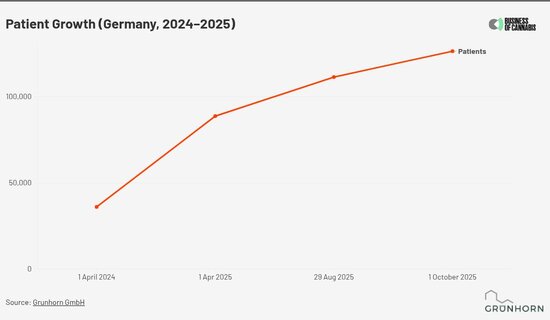
According to Grunhorn’s proprietary data, it had around 36,000 patients on its roster before the implementation of CanG, and estimates that the total number of patients throughout the country was between 200,000 and 300,000.
Grunhorn’s entrance to the market came at the tail end of the so-called ‘green rush’, where the emergence of medical cannabis has seen huge investment and even bigger valuations sweep the sector, mostly in North America.
Yet, even with the global excitement around the industry and Germany leading the way in Europe, growth was steady, and enthusiasm around the market remained muted.
“I grew up in the US, so I’d been following the cannabis market there for a long time,” Fritsch continued.
“I think the excitement came when they first announced they were going to change something about cannabis. Before then, it was still very much a narcotic. People held themselves back in terms of marketing and investing in infrastructure. The real buzz started when it looked like the government was going to form, with those three parties, and cannabis reform was on their agenda. That’s when it really began.”

October 7, 2025 No Comments

October 7, 2025 No Comments

October 2, 2025 No Comments
On April 01, 2024, after an extended period of political wrangling, CanG was implemented across Germany, instantly transforming the market beyond even the most optimistic stakeholders expectations.
With even the final vote coming down to the wire, the bill’s removal of cannabis from the list of narcotic substances, which removed many of the burdensome restrictions on patients and prescribers, unleashed an immediate tidal wave of applications.
Fritsch reflected: “Even when the regulation came, we didn’t think it would develop that fast. We thought it would be steady, year-on-year growth, nothing exponential.
“In March, we didn’t even know the law was going to go through until the last minute. I’ll never forget it: Easter with my family, my IT guys calling, saying we had a ton of prescriptions coming in on day one and didn’t know what to do with them. They were PDFs with qualified signatures, but we’d been preparing for e-prescriptions.
“We had to call our lawyers to check the legal background before delivering. The first week was chaos, prescriptions flooding in, legal scrambling. We figured it out, got orders out, and growth continued.”
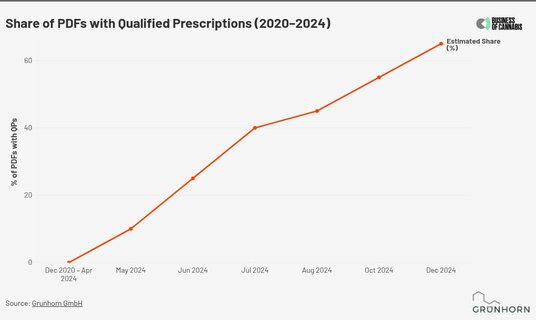
Despite the unexpected torrent of prescriptions, Fritsch believes his company’s ability to rapidly adapt and ‘scale under extreme pressure’ was a critical lesson, and one that has allowed Grunhorn to ride the wave of growth.
“Within 48 hours we adjusted our systems, processed the backlog, and made sure patients got their medicine without interruption. That ability to adapt fast is what sets us apart.”
Since that day, Fritsch estimates that the number of patients in the German market (no longer tracked by official data), could have more than trippled based on its own internal figures, rising from 200,000 – 300,000 to between 1m and 1.2m as of Q3 2025.
Grunhorn’s own patient numbers spiked 146% in the first year, rising from just over 36,000 to 88,656, with the rate of growth continuing to accelerate throughout the year. By October 2025, this number had increased to over 126,295.
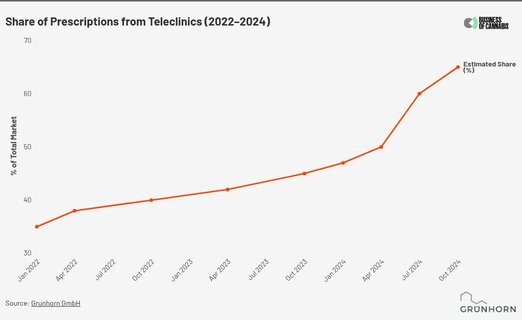
Telemedicine clinics were already playing an increasingly important role before CanG, but few anticipated the critical and increasingly controversial role they would play in shaping the German market.
According to Fritsch, while he had expected growth in these services to build up to ‘something exponential’, the industry anticipated this would take time, enabling teleclinics to gradually amend their models to serve the new demand.
“We didn’t know so many teleclinics were ready to go day one.”
Like many of its competitors, Grunhorn has had to adapt to work with this new market reality, implementing software changes to accommodate new prescription types, and integrating new technology to meet demand efficiently.
“We used to have a dedicated team of licensed professionals who would meet doctors in person to talk about cannabis. We also did a lot of presentations at conventions to educate doctors. That’s become much easier now, but the real shift has been toward the online side. Most of the changes have been tech-driven, and some older requirements have simply fallen away.”
With the political pushback on the explosion of online prescriptions now reaching a meaningful head, there is a widespread expectation that the market will consolidate significantly. Those whose models rely solely on the loosely regulated online prescription market are likely to either cash out, or struggle to keep their head above water in the case of a crackdown.
For Grunhorn, which has a was growing long before CanG came in, threats of a crackdown are less troubling.
“Before legalization, we worked with 7,000 doctors across Germany. Many of them lost patients to online clinics, but we still have the platform, the patient base, and the doctor relationships.
“For us, the market might shrink, but we’d also have fewer competitors. That’s an advantage. We’d need to invest in some additional infrastructure for distribution, but with the patient and doctor data we already have, we could handle it.
“Essentially, if the government limits teleclinics, we’d adapt by connecting patients to the doctors within our network.”
The post ‘No One Expected the Surge’: Grunhorn on How Telemedicine Took German Medical Cannabis by Storm appeared first on Business of Cannabis.
Continue reading...
The runaway growth of its medical market remains the envy of industry stakeholders throughout Europe, and is increasingly drawing the attention of some of the world’s largest cannabis companies and investment firms.
As the EU’s most populous country, and one of the first to legalise medical cannabis in 2017, Germany was already emerging as the regional frontrunner by the late 2010s.
While its potential as a market has always been clear, the explosion of growth brought about by Germany’s ‘Cannabis Act’ took even the most well-connected and experienced industry operators by surprise.
Stefan Fritsch, the founder and CEO of Grunhorn, one of Germany’s longest-running and largest cannabis groups, told Business of Cannabis: “No one expected a big ‘day one’ surge.
“Everyone assumed it would be gradual — even if companies were ready to prescribe cannabis, we didn’t think patients would immediately rush to get prescriptions on the first day. That was a huge surprise.”
A sleeping giant
Germany’s 2017 ‘Cannabis as Medicine Act’ (Cannabis als Medizin Gesetz) was itself a major milestone for the market, positioning it as the continent’s largest medical market almost overnight.
Following its implementation, patients had access to cannabis flowers and extracts for the first time, and public health insurers were obliged to cover treatment costs in justified cases, making it one of the few markets globally to reimburse patients.
However, early growth was slow. Few doctors were actively prescribing, even fewer pharmacies were dispensing, and the country was reliant on imports from the emerging North American and nascent European markets.
Fritsch explained: “I don’t think anybody really had a vision for the market at all back then. Politicians weren’t talking about medical cannabis changes, and sales weren’t exciting. I think there were maybe four pharmacies selling cannabis and five manufacturers importing it.
“Cannabis was legalised in 2017, so there were about three years of no action. When we started (in 2020), it was the same thing—nobody really had much focus on it outside of the importers. The number of patients only increased gradually.”
According to Grunhorn’s proprietary data, it had around 36,000 patients on its roster before the implementation of CanG, and estimates that the total number of patients throughout the country was between 200,000 and 300,000.
Grunhorn’s entrance to the market came at the tail end of the so-called ‘green rush’, where the emergence of medical cannabis has seen huge investment and even bigger valuations sweep the sector, mostly in North America.
Yet, even with the global excitement around the industry and Germany leading the way in Europe, growth was steady, and enthusiasm around the market remained muted.
“I grew up in the US, so I’d been following the cannabis market there for a long time,” Fritsch continued.
“I think the excitement came when they first announced they were going to change something about cannabis. Before then, it was still very much a narcotic. People held themselves back in terms of marketing and investing in infrastructure. The real buzz started when it looked like the government was going to form, with those three parties, and cannabis reform was on their agenda. That’s when it really began.”
Inside Australia’s Medical Cannabis Boom: Prescriptions, Products & Patients
Read More »October 7, 2025 No Comments
Import Approvals Paused as Germany Hits 2025 Medical Cannabis Limit
Read More »October 7, 2025 No Comments
What Does the First Official Data on Germany’s Cannabis Reforms Show?
Read More »October 2, 2025 No Comments
The CanG explosion
On April 01, 2024, after an extended period of political wrangling, CanG was implemented across Germany, instantly transforming the market beyond even the most optimistic stakeholders expectations.
With even the final vote coming down to the wire, the bill’s removal of cannabis from the list of narcotic substances, which removed many of the burdensome restrictions on patients and prescribers, unleashed an immediate tidal wave of applications.
Fritsch reflected: “Even when the regulation came, we didn’t think it would develop that fast. We thought it would be steady, year-on-year growth, nothing exponential.
“In March, we didn’t even know the law was going to go through until the last minute. I’ll never forget it: Easter with my family, my IT guys calling, saying we had a ton of prescriptions coming in on day one and didn’t know what to do with them. They were PDFs with qualified signatures, but we’d been preparing for e-prescriptions.
“We had to call our lawyers to check the legal background before delivering. The first week was chaos, prescriptions flooding in, legal scrambling. We figured it out, got orders out, and growth continued.”
Despite the unexpected torrent of prescriptions, Fritsch believes his company’s ability to rapidly adapt and ‘scale under extreme pressure’ was a critical lesson, and one that has allowed Grunhorn to ride the wave of growth.
“Within 48 hours we adjusted our systems, processed the backlog, and made sure patients got their medicine without interruption. That ability to adapt fast is what sets us apart.”
Since that day, Fritsch estimates that the number of patients in the German market (no longer tracked by official data), could have more than trippled based on its own internal figures, rising from 200,000 – 300,000 to between 1m and 1.2m as of Q3 2025.
Grunhorn’s own patient numbers spiked 146% in the first year, rising from just over 36,000 to 88,656, with the rate of growth continuing to accelerate throughout the year. By October 2025, this number had increased to over 126,295.
Telemedicine surge
Telemedicine clinics were already playing an increasingly important role before CanG, but few anticipated the critical and increasingly controversial role they would play in shaping the German market.
According to Fritsch, while he had expected growth in these services to build up to ‘something exponential’, the industry anticipated this would take time, enabling teleclinics to gradually amend their models to serve the new demand.
“We didn’t know so many teleclinics were ready to go day one.”
Like many of its competitors, Grunhorn has had to adapt to work with this new market reality, implementing software changes to accommodate new prescription types, and integrating new technology to meet demand efficiently.
“We used to have a dedicated team of licensed professionals who would meet doctors in person to talk about cannabis. We also did a lot of presentations at conventions to educate doctors. That’s become much easier now, but the real shift has been toward the online side. Most of the changes have been tech-driven, and some older requirements have simply fallen away.”
With the political pushback on the explosion of online prescriptions now reaching a meaningful head, there is a widespread expectation that the market will consolidate significantly. Those whose models rely solely on the loosely regulated online prescription market are likely to either cash out, or struggle to keep their head above water in the case of a crackdown.
For Grunhorn, which has a was growing long before CanG came in, threats of a crackdown are less troubling.
“Before legalization, we worked with 7,000 doctors across Germany. Many of them lost patients to online clinics, but we still have the platform, the patient base, and the doctor relationships.
“For us, the market might shrink, but we’d also have fewer competitors. That’s an advantage. We’d need to invest in some additional infrastructure for distribution, but with the patient and doctor data we already have, we could handle it.
“Essentially, if the government limits teleclinics, we’d adapt by connecting patients to the doctors within our network.”
The post ‘No One Expected the Surge’: Grunhorn on How Telemedicine Took German Medical Cannabis by Storm appeared first on Business of Cannabis.
Continue reading...


