
Last week, Switzerland took a decisive lead in the region’s rapidly evolving efforts to reform cannabis prohibition, detailing plans that could see Europe’s first commercial (though not-for-profit) adult-use cannabis market launched by next year.
As Germany’s reformation efforts look increasingly likely to be kneecapped just over a year in, and the Czech Republic’s plans for full legalisation similarly curbed for the time being, Switzerland is emerging as a standard bearer for public-health-focused cannabis policy.
That said, as the details of its ambitious proposals continue to be pored over by analysts and industry stakeholders alike, there is growing concern and many unanswered questions about some of its hallmark policies.
Cannavigia, a compliance technology firm at the heart of Switzerland’s cannabis industry, already deeply embedded across the state’s various adult-use pilot projects, sees both opportunities and challenges emerging from the current draft.
It’s Co-Founder and Chief Strategy Officer, Luc Richner, told Business of Cannabis: “The challenge will be to strike a balance—ensuring safety and public health while still creating products that consumers actually want.
“This is where ongoing consultation with industry players will be essential.”

September 3, 2025 No Comments
One of the standout proposals from the newly released draft is that of a single national concession for online cannabis sales.
Placing the entire country’s online cannabis sales in the hands of a single, state-governed entity keeps these plans in line with the overarching prioritisation of consumer protection over profit. However, commercial monopolies rarely lead to the best results for the consumer.
This strategy, Richner comments, is ‘both bold and risky’.
“On the one hand, it could ensure strong oversight and consumer safety. On the other, it risks stifling innovation and limiting choice. Ideally, the system would find a balance—perhaps starting with a single operator but gradually opening to competition once the framework proves stable.
“For companies like ours, it means we need to think creatively about how to collaborate with whichever entity is selected, ensuring consumers still benefit from variety and quality.”
While this framework will be unique to Europe, there are insights to be gained from Canada’s most populous province, Ontario.
Ontario offers one of the closest parallels to Switzerland’s draft framework, having operated a single state-run online retailer through the Ontario Cannabis Store (OCS) since cannabis was legalised in 2018.
Initially intended to be temporary while retail stores expanded across the state, political changes have meant the OCS has retained a monopoly over online sales in Canada.
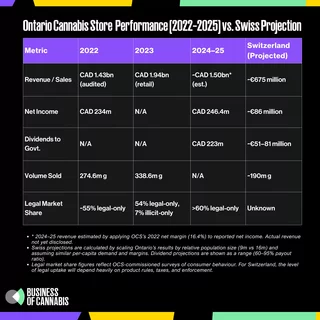
In its recently published ‘OCS Social Impact Report 2024–25’, the entity reported net income of C$246.4m last year, of which C$223 million was returned to the province in dividends. While Switzerland is pursuing a much different taxation scheme, this demonstrates the potential revenue generation for public health projects.
Projecting by the current population of Ontario and Switzerland, using data from OCS reports from 2022, 2023 and 2024, we can get some idea of the size Switzerland’s online retailer could reach when it matures.
While some heavily caveated projections can be made based on Ontario, there are several critical details missing in the available draft text.
“At this stage, it’s not fully clear and everything would be speculation. Don’t forget this the draft for the consultation phase so it naturally leaves room for speculation and, frankly, some anxiety in the industry,” Richner explained.
For example, it’s not yet clear whether this state-run entity will be built from the ground up by the government or whether it will nominate a suitable candidate from the private sector.
Cannavigia, through its Cannabis Dispensary System (CDS), has already established itself as Switzerland’s backbone for cannabis compliance and retail monitoring. Under an exclusive ten-year contract with the Federal Office of Public Health, the company manages all adult-use pilot projects in the country, with its software deployed across pharmacies, dispensaries, social clubs and drug information centres.
With this in mind, Cannavigia would likely be considered a frontrunner if policymakers opt to consider a private player with an already established operation.
“We hope that policymakers recognise the expertise and infrastructure already present in the private sector and leverage it rather than trying to build everything from scratch. Switzerland can benefit from combining state oversight with private-sector efficiency and know-how,” Richner continued.
Asked which sectors would be best suited for this task, he said: “Cannabis companies certainly bring deep product knowledge and compliance experience, while retail and pharma players bring established logistics and distribution expertise.
“A Hybrid approach, where partnerships between these groups are encouraged, may be the most sustainable solution. The key is to ensure that the market remains open enough for new entrants and innovative business models, not only large incumbents.”
The post Switzerland Plans for a Single Online Cannabis Retailer: What Will This Mean for its Upcoming Adult-Use Market? appeared first on Business of Cannabis.
Continue reading...
As Germany’s reformation efforts look increasingly likely to be kneecapped just over a year in, and the Czech Republic’s plans for full legalisation similarly curbed for the time being, Switzerland is emerging as a standard bearer for public-health-focused cannabis policy.
That said, as the details of its ambitious proposals continue to be pored over by analysts and industry stakeholders alike, there is growing concern and many unanswered questions about some of its hallmark policies.
Cannavigia, a compliance technology firm at the heart of Switzerland’s cannabis industry, already deeply embedded across the state’s various adult-use pilot projects, sees both opportunities and challenges emerging from the current draft.
It’s Co-Founder and Chief Strategy Officer, Luc Richner, told Business of Cannabis: “The challenge will be to strike a balance—ensuring safety and public health while still creating products that consumers actually want.
“This is where ongoing consultation with industry players will be essential.”
Inside Switzerland’s Cannabis Legalisation Plans
Read More »September 3, 2025 No Comments
Online retail is restricted to a single operator
One of the standout proposals from the newly released draft is that of a single national concession for online cannabis sales.
Placing the entire country’s online cannabis sales in the hands of a single, state-governed entity keeps these plans in line with the overarching prioritisation of consumer protection over profit. However, commercial monopolies rarely lead to the best results for the consumer.
This strategy, Richner comments, is ‘both bold and risky’.
“On the one hand, it could ensure strong oversight and consumer safety. On the other, it risks stifling innovation and limiting choice. Ideally, the system would find a balance—perhaps starting with a single operator but gradually opening to competition once the framework proves stable.
“For companies like ours, it means we need to think creatively about how to collaborate with whichever entity is selected, ensuring consumers still benefit from variety and quality.”
Lessons from across the Atlantic
While this framework will be unique to Europe, there are insights to be gained from Canada’s most populous province, Ontario.
Ontario offers one of the closest parallels to Switzerland’s draft framework, having operated a single state-run online retailer through the Ontario Cannabis Store (OCS) since cannabis was legalised in 2018.
Initially intended to be temporary while retail stores expanded across the state, political changes have meant the OCS has retained a monopoly over online sales in Canada.
In its recently published ‘OCS Social Impact Report 2024–25’, the entity reported net income of C$246.4m last year, of which C$223 million was returned to the province in dividends. While Switzerland is pursuing a much different taxation scheme, this demonstrates the potential revenue generation for public health projects.
Projecting by the current population of Ontario and Switzerland, using data from OCS reports from 2022, 2023 and 2024, we can get some idea of the size Switzerland’s online retailer could reach when it matures.
Questions remain
While some heavily caveated projections can be made based on Ontario, there are several critical details missing in the available draft text.
“At this stage, it’s not fully clear and everything would be speculation. Don’t forget this the draft for the consultation phase so it naturally leaves room for speculation and, frankly, some anxiety in the industry,” Richner explained.
For example, it’s not yet clear whether this state-run entity will be built from the ground up by the government or whether it will nominate a suitable candidate from the private sector.
Cannavigia, through its Cannabis Dispensary System (CDS), has already established itself as Switzerland’s backbone for cannabis compliance and retail monitoring. Under an exclusive ten-year contract with the Federal Office of Public Health, the company manages all adult-use pilot projects in the country, with its software deployed across pharmacies, dispensaries, social clubs and drug information centres.
With this in mind, Cannavigia would likely be considered a frontrunner if policymakers opt to consider a private player with an already established operation.
“We hope that policymakers recognise the expertise and infrastructure already present in the private sector and leverage it rather than trying to build everything from scratch. Switzerland can benefit from combining state oversight with private-sector efficiency and know-how,” Richner continued.
Asked which sectors would be best suited for this task, he said: “Cannabis companies certainly bring deep product knowledge and compliance experience, while retail and pharma players bring established logistics and distribution expertise.
“A Hybrid approach, where partnerships between these groups are encouraged, may be the most sustainable solution. The key is to ensure that the market remains open enough for new entrants and innovative business models, not only large incumbents.”
The post Switzerland Plans for a Single Online Cannabis Retailer: What Will This Mean for its Upcoming Adult-Use Market? appeared first on Business of Cannabis.
Continue reading...
