
Jersey’s medical cannabis industry turned a profit for the first time in 2025, posting revenues of £12m, almost £50m in cumulative investment, and exports of nearly seven tonnes.
For an Island with a population the size of an average English market town, these figures should give any comparable jurisdiction pause for thought.
Alongside other British Crown Dependencies, Jersey has welcomed the cannabis industry with open arms and has quietly cemented itself as the most advanced cannabis jurisdiction in the British Isles.
With a new bill seeking to decriminalise cannabis waiting in the wings ahead of a general election next month, the market could take another leap ahead of the mainland.
For those already operating on the Island, Jersey is already well on its way to becoming one of the leading destinations for cannabis businesses, not just in the British Isles, but in the world.
“Jersey moved really early. We’ve learned quickly. And now we’re building a quality-led model — something that will take us forward over the next ten years,” Evan Smith, founder of Cicada Limited, a Jersey-based cannabis process design and engineering consultancy, told Business of Cannabis.
“The good news is there is no first-mover advantage in producing cannabis. There is only a first-mover advantage in regulating it well. And that’s where Jersey has, I think, the most exciting opportunity of any jurisdiction across the entire global industry.”
Jersey issued its first commercial cannabis cultivation licences in December 2020, the first in the British Isles since GW Pharmaceuticals in 1998. General practitioners on the island do not require a special licence to prescribe medical cannabis, and around 4% of the adult population now holds a prescription.
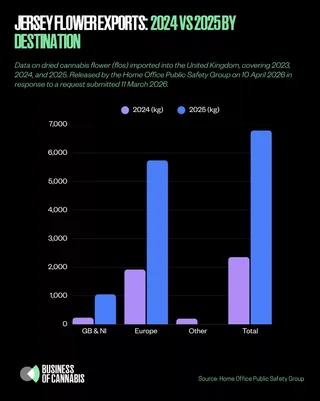
New data obtained by Prohibition Partners via Freedom of Information (FOI) requests shows Jersey exported 6,786 kilograms of dried cannabis flower in 2025, nearly triple the previous year’s figure, with exports to Great Britain and Northern Ireland alone growing by 348%.
Illicit cannabis imports, meanwhile, fell from 146 kilograms in 2017 to just 15.9 kilograms in 2024, with officials attributing the decline largely to displacement by the legal medical supply.
In 2021, the States Assembly amended Jersey’s Proceeds of Crime Law specifically for cannabis, meaning income from the sale of recreational cannabis in approximately 30 jurisdictions with adequate anti-money laundering frameworks no longer becomes criminalised on entering the island.
This very simple change, as we have covered previously, is now being called for by hemp industry advocates in the UK, and helped send a signal to the global cannabis industry that it was open for business.
Jersey’s export framework has followed the same logic of deliberate differentiation, and now operates what Smith describes as the fastest export permit turnaround globally. Thanks to its location halfway between the British mainland and France, a two-hour ferry to mainland France can see product reach Germany within 36 hours.
While taken in relative terms, the growth of its medical cannabis industry is enviable, exports are dominated by a single company, Northern Leaf, which now accounts for an estimated 90% of current production.
The company, which invested multiple millions in constructing the island’s largest EU-GMP certified facility, a 100,000-square-foot site in St Lawrence, has pulled itself back from ‘serious financial difficulty’ in recent months,
In 2025, it supplied 3,590 kilograms to Germany, making it the largest UK exporter of medical cannabis flower into that market.
Furthermore, the sheer size of rival exporters like Canada, which now supplies some 57% of the UK’s medical cannabis, means Jersey simply cannot compete on scale.
“I would describe our framework as being very permissive, and I don’t think that’s the place where Jersey wants to compete long term,” Smith stated.
“Simply exporting bulk API into Germany, I don’t see a differentiated value proposition for Jersey as compared to other jurisdictions like Malta or Macedonia, where there’s probably a facility somewhere the size of our entire island.”
Jersey’s cannabis producers currently export dried flower in bulk, raw material that other companies then process, package, brand and sell on to patients and pharmacies. The profit from those downstream steps, the finished product that ends up on a pharmacy shelf, stays with whoever does that work.
As Smith puts it: “The most valuable part of the value chain is being shipped off island.”
Smith, a self-confessed ‘regulation nerd’, believes changing this dynamic requires a significant change in the fundamental structure underpinning not just Jersey’s cannabis industry, but the industry as a whole.
The global cannabis industry, he argues, built its quality frameworks around the wrong foundation. The international pharmaceutical development standard known as ICH Q8, which requires manufacturers to identify critical quality attributes and the process parameters needed to maintain them consistently, was largely skipped for cannabis because unlicensed products were never required to go through the marketing authorisation process that demands it.
“Everything’s been skipped because it’s an unlicensed medicine,” Smith explained. “You haven’t gone through marketing authorisation, clinical trials, and you haven’t been forced to start with ICH Q8. Before you go into developing your process and using your risk management, that’s Q9, your pharmaceutical quality systems in Q10, your GMP for API facilities in Q7, everything’s missing that core fundamental component.”
A key example of the impact this has had on the industry can be seen in Canada, which licensed 800 producers in 2018, each claiming readiness to export to Germany. The number of companies that successfully achieved GMP certification in the following few years can be counted on one hand.
Indeed, according to Smith, many of the certificates that were granted are now being revoked as inspectors return and find quality management systems that never functioned as designed.
“We treated cannabis like a strawberry instead of a medicine,” Smith, himself a Canadian, said. “We never enforced GMP on the producers.”
The small island’s characteristics and industrial heritage give Jersey the opportunity to create a unique offering in this rapidly evolving industry.
It has ‘some of the cheapest and greenest electricity in Europe’, better suited to controlled indoor production than the greenhouse cultivation that dominates sunnier competing jurisdictions, where temperature differentials drive condensation and mould risk.
Jersey’s own regulators also play a major part, having shown a willingness to move at commercial speed, meaning rapid export certification.
Despite its apparent efforts to clear the path for cannabis businesses, Jersey’s government has recently demonstrated that it is still both willing and capable of blocking it.
But the gap between that potential and current reality has sharpened. Yesterday, the Jersey Evening Post reported that two locally-owned producers, Green Island Growers and Caprica, have achieved GMP Part One certification, the higher standard that permits the manufacture and release of finished medicinal products.
However, they have been unable to obtain the manufacturing licences that would allow them to use it. Caprica received MHRA certification in October 2025. In April 2026, the island’s government confirmed it could not issue manufacturing licences because the necessary regulatory framework was not yet in place.
Health and Care Jersey said in a statement that an initial review had concluded the current system was ‘not sufficiently robust’, and that work had begun on improving medicines manufacturing licensing processes.
Green Island chief executive Neel Sahai told the publication: “To be told at this late stage that the government is not yet able to issue manufacturing licences is a little bit crazy, to be honest. The opportunity is real, it is ready to be grasped, and the producers are ready to grab hold.”
Failure to develop Jersey’s regulatory and infrastructure framework more broadly, according to Smith, could be existential for the industry: “Otherwise, over the next few years, companies will move more towards a distribution model, and production will naturally be outsourced to third-party countries overseas.
“In my view, that would be missing a one-time opportunity for Jersey to become a major player in global cannabis cultivation.” Eight years in, the island has built something real. Whether it capitalises on it is now a political question as much as a commercial one.
The post Jersey’s Cannabis Industry Posts First Profit as Exports Triple, But the Real Value Is Still Leaving the Island appeared first on Business of Cannabis.
Continue reading...
For an Island with a population the size of an average English market town, these figures should give any comparable jurisdiction pause for thought.
Alongside other British Crown Dependencies, Jersey has welcomed the cannabis industry with open arms and has quietly cemented itself as the most advanced cannabis jurisdiction in the British Isles.
With a new bill seeking to decriminalise cannabis waiting in the wings ahead of a general election next month, the market could take another leap ahead of the mainland.
For those already operating on the Island, Jersey is already well on its way to becoming one of the leading destinations for cannabis businesses, not just in the British Isles, but in the world.
“Jersey moved really early. We’ve learned quickly. And now we’re building a quality-led model — something that will take us forward over the next ten years,” Evan Smith, founder of Cicada Limited, a Jersey-based cannabis process design and engineering consultancy, told Business of Cannabis.
“The good news is there is no first-mover advantage in producing cannabis. There is only a first-mover advantage in regulating it well. And that’s where Jersey has, I think, the most exciting opportunity of any jurisdiction across the entire global industry.”
Opened early
Jersey issued its first commercial cannabis cultivation licences in December 2020, the first in the British Isles since GW Pharmaceuticals in 1998. General practitioners on the island do not require a special licence to prescribe medical cannabis, and around 4% of the adult population now holds a prescription.
New data obtained by Prohibition Partners via Freedom of Information (FOI) requests shows Jersey exported 6,786 kilograms of dried cannabis flower in 2025, nearly triple the previous year’s figure, with exports to Great Britain and Northern Ireland alone growing by 348%.
Illicit cannabis imports, meanwhile, fell from 146 kilograms in 2017 to just 15.9 kilograms in 2024, with officials attributing the decline largely to displacement by the legal medical supply.
In 2021, the States Assembly amended Jersey’s Proceeds of Crime Law specifically for cannabis, meaning income from the sale of recreational cannabis in approximately 30 jurisdictions with adequate anti-money laundering frameworks no longer becomes criminalised on entering the island.
This very simple change, as we have covered previously, is now being called for by hemp industry advocates in the UK, and helped send a signal to the global cannabis industry that it was open for business.
Jersey’s export framework has followed the same logic of deliberate differentiation, and now operates what Smith describes as the fastest export permit turnaround globally. Thanks to its location halfway between the British mainland and France, a two-hour ferry to mainland France can see product reach Germany within 36 hours.
The most valuable parts are being ‘shipped off the island’
While taken in relative terms, the growth of its medical cannabis industry is enviable, exports are dominated by a single company, Northern Leaf, which now accounts for an estimated 90% of current production.
The company, which invested multiple millions in constructing the island’s largest EU-GMP certified facility, a 100,000-square-foot site in St Lawrence, has pulled itself back from ‘serious financial difficulty’ in recent months,
In 2025, it supplied 3,590 kilograms to Germany, making it the largest UK exporter of medical cannabis flower into that market.
Furthermore, the sheer size of rival exporters like Canada, which now supplies some 57% of the UK’s medical cannabis, means Jersey simply cannot compete on scale.
“I would describe our framework as being very permissive, and I don’t think that’s the place where Jersey wants to compete long term,” Smith stated.
“Simply exporting bulk API into Germany, I don’t see a differentiated value proposition for Jersey as compared to other jurisdictions like Malta or Macedonia, where there’s probably a facility somewhere the size of our entire island.”
Jersey’s cannabis producers currently export dried flower in bulk, raw material that other companies then process, package, brand and sell on to patients and pharmacies. The profit from those downstream steps, the finished product that ends up on a pharmacy shelf, stays with whoever does that work.
As Smith puts it: “The most valuable part of the value chain is being shipped off island.”
READ MORE…
Jersey’s Cannabis Industry Posts First Profit as Exports Triple, But the Real Value Is Still Leaving the Island

Jersey to Debate Cannabis Decriminalisation, CBD Final Authorisations Not Due Until 2025, & Ireland to Get First Medical Cannabis Cultivation Facility
Jersey Hemp Wins Watershed Legal Battle Against UK Home Office Which Threatened Entire CBD Industry
ICH Q8
Smith, a self-confessed ‘regulation nerd’, believes changing this dynamic requires a significant change in the fundamental structure underpinning not just Jersey’s cannabis industry, but the industry as a whole.
The global cannabis industry, he argues, built its quality frameworks around the wrong foundation. The international pharmaceutical development standard known as ICH Q8, which requires manufacturers to identify critical quality attributes and the process parameters needed to maintain them consistently, was largely skipped for cannabis because unlicensed products were never required to go through the marketing authorisation process that demands it.
“Everything’s been skipped because it’s an unlicensed medicine,” Smith explained. “You haven’t gone through marketing authorisation, clinical trials, and you haven’t been forced to start with ICH Q8. Before you go into developing your process and using your risk management, that’s Q9, your pharmaceutical quality systems in Q10, your GMP for API facilities in Q7, everything’s missing that core fundamental component.”
A key example of the impact this has had on the industry can be seen in Canada, which licensed 800 producers in 2018, each claiming readiness to export to Germany. The number of companies that successfully achieved GMP certification in the following few years can be counted on one hand.
Indeed, according to Smith, many of the certificates that were granted are now being revoked as inspectors return and find quality management systems that never functioned as designed.
“We treated cannabis like a strawberry instead of a medicine,” Smith, himself a Canadian, said. “We never enforced GMP on the producers.”
The small island’s characteristics and industrial heritage give Jersey the opportunity to create a unique offering in this rapidly evolving industry.
It has ‘some of the cheapest and greenest electricity in Europe’, better suited to controlled indoor production than the greenhouse cultivation that dominates sunnier competing jurisdictions, where temperature differentials drive condensation and mould risk.
Jersey’s own regulators also play a major part, having shown a willingness to move at commercial speed, meaning rapid export certification.
Despite its apparent efforts to clear the path for cannabis businesses, Jersey’s government has recently demonstrated that it is still both willing and capable of blocking it.
But the gap between that potential and current reality has sharpened. Yesterday, the Jersey Evening Post reported that two locally-owned producers, Green Island Growers and Caprica, have achieved GMP Part One certification, the higher standard that permits the manufacture and release of finished medicinal products.
However, they have been unable to obtain the manufacturing licences that would allow them to use it. Caprica received MHRA certification in October 2025. In April 2026, the island’s government confirmed it could not issue manufacturing licences because the necessary regulatory framework was not yet in place.
Health and Care Jersey said in a statement that an initial review had concluded the current system was ‘not sufficiently robust’, and that work had begun on improving medicines manufacturing licensing processes.
Green Island chief executive Neel Sahai told the publication: “To be told at this late stage that the government is not yet able to issue manufacturing licences is a little bit crazy, to be honest. The opportunity is real, it is ready to be grasped, and the producers are ready to grab hold.”
Failure to develop Jersey’s regulatory and infrastructure framework more broadly, according to Smith, could be existential for the industry: “Otherwise, over the next few years, companies will move more towards a distribution model, and production will naturally be outsourced to third-party countries overseas.
“In my view, that would be missing a one-time opportunity for Jersey to become a major player in global cannabis cultivation.” Eight years in, the island has built something real. Whether it capitalises on it is now a political question as much as a commercial one.
The post Jersey’s Cannabis Industry Posts First Profit as Exports Triple, But the Real Value Is Still Leaving the Island appeared first on Business of Cannabis.
Continue reading...


